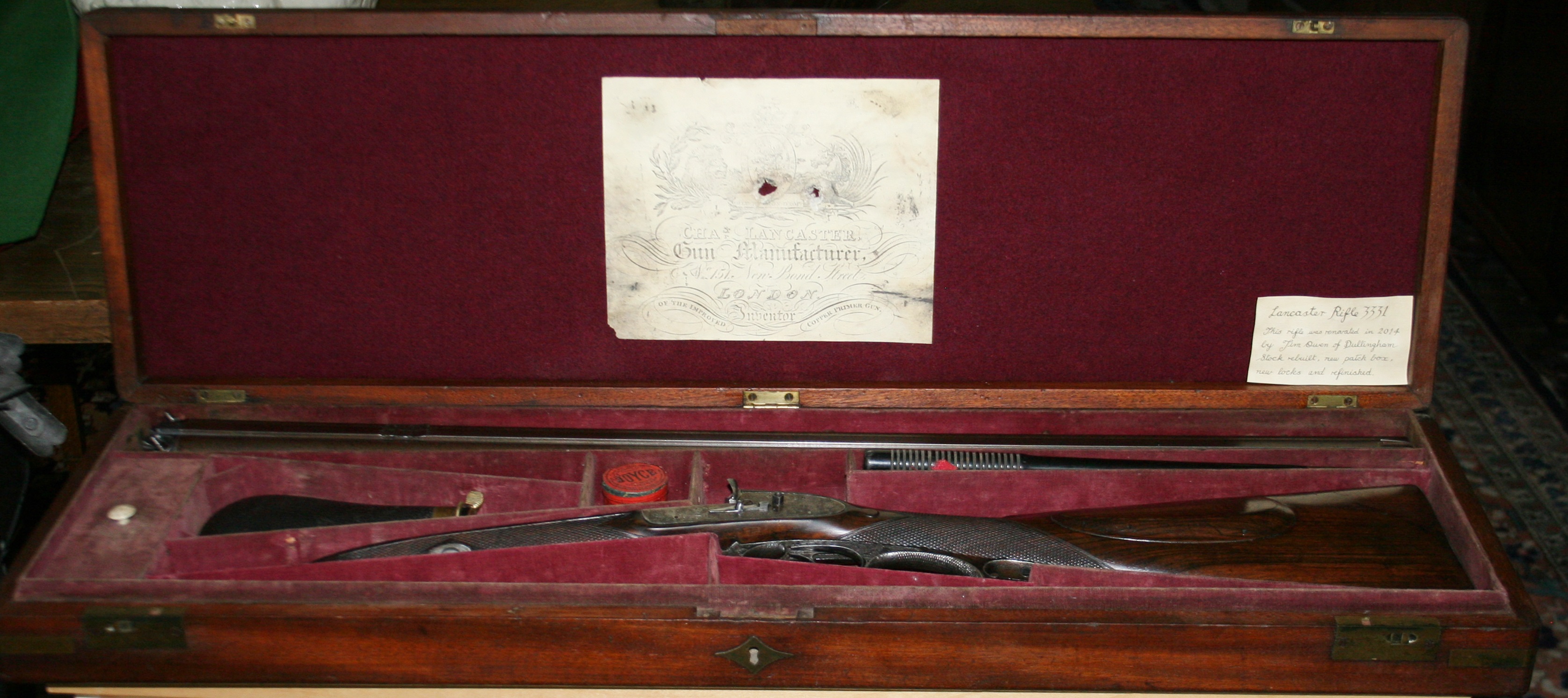
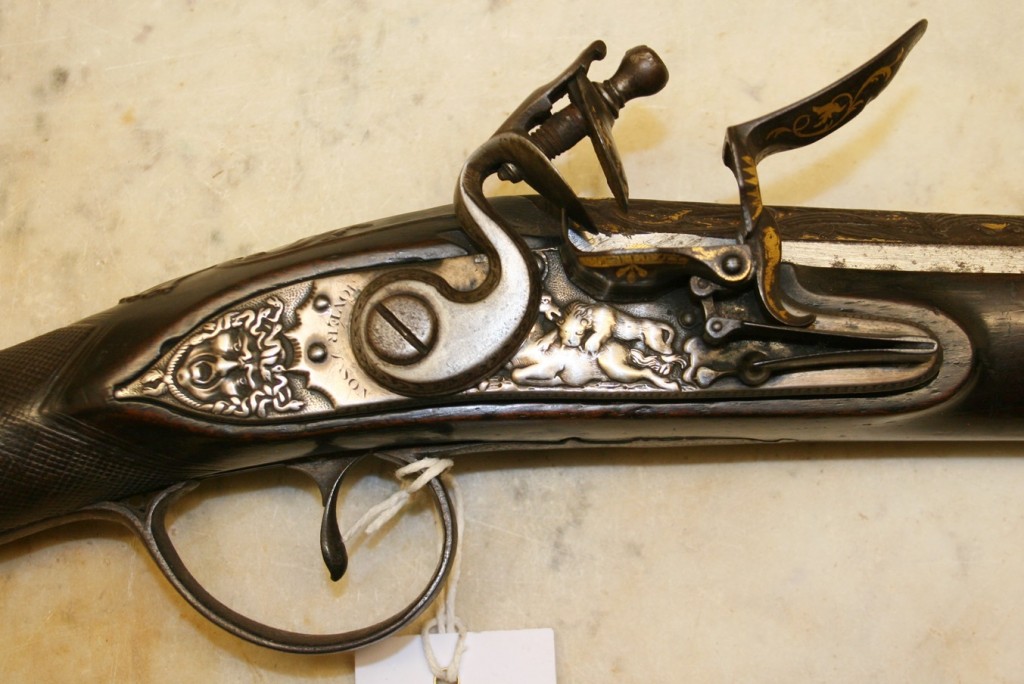
Charles Lancaster patented the oval bore rifling, although he wasn’t actually the inventor. I purchased a cased Lancaster double rifle in excellent condition (serial No. 3076 for 185X) and then acquired a complete wreck of a very similar gun. The stock had been burnt, the locks very crudely replaced with rebounding Stanton locks from a breech loader extended to fit the opening, and a major crack running right through the action area. I didn’t take photos of the ‘before’ state, but the work involved splicing a new heel on the butt – which my friend Dick did for me as my woodwork was not so hot ( its better now) and some additional woodwork that I did manage, including replacing almost all of the wood between the two locks. I made a pair of new lockplates, fitted with the modified Stanton insides, and made new main springs. I engraved the lock plates as an exact copy of the locks on my ‘good’ Lancaster. The good Lancaster had a circular patch box but there wasn’t one on the wreck, but there was a nasty burn mark on the stock where a patch box would fit, so I made one – but rectangular to cover the entire burn mark and engraved it to match the good one – keeping the circular reference of the original. I’m not sure I engraved the lion deeply enough, but otherwise I’m pretty happy with it – it shuts with a suitable snap. Stock is finished with dozens of coats of ‘Slacum’ – a mixture of boiled Linseed oil, beeswax and terbine driers, put on and then rubbed off as it goes through the jelly stage. I had a reasonably suitable case that fitted well, which I modified inside, and made a set of tools with ebony handles. I haven’t attempted to pass this rebuild off as original – the locks and patch box are engraved with my name and the year to avoid confusing future collectors and the case carries a ‘confession’ notice!
These pictures are what I have to hand – I’ll try to take some better ones sometime! Click on the pictures to enlarge to full screen.